SALT RESEARCH
CRYPT-LEVEL CONSTRUCTION IN NEW GOTHIC CATHEDRAL’S LIKE
ST. PATRICK’S CATHEDRAL – NYC
November 14, 2008
St. Patrick’s Cathedral (http://en.wikipedia.org/wiki/St._Patrick's_Cathedral,_New_York) is a Roman Catholic Cathedral built in the gothic revival style
(http://en.wikipedia.org/wiki/Gothic_revival). The cathedral was completed in 1878 and renovated in 1927 and 1931. The cathedral, including the crypt, is made of white marble and in keeping with the Gothic Revival style would have been constructed in similar fashion to the Gothic architecture (http://en.wikipedia.org/wiki/Gothic_architecture) that influenced it’s design. A hallmark of gothic construction is the stone skeleton made up of clustered columns (piers), pointed arches and flying buttresses. Ashlar masonry
(http://en.wikipedia.org/wiki/Ashlar) is the general construction technique used in which regularly cut blocks of stone, generally smoothed or polished, are the main structural material. In early gothic buildings no mortar would be used but in later construction, during the gothic revival period, Portland Mortar was the most commonly used mortar in building.
“If the building has both a stone floor on the ground level and a basement, the basement has to have stone pillars in it to support the stone floor above it, and the basement also has to have a stone floor itself (or else the pillars will sink into the ground under the weight of the stone floor above). And finally, because arches are much stronger than flat ceilings, there would probably need to be arches between the pillars)
http://www.absolutewrite.com/forums/showthread.php?p=2747069). This is structurally consistent with crypt construction in both original gothic cathedrals and gothic revival buildings.
The cathedral of St. John the Divine, is another gothic revival cathedral in New York City (http://www.nyc-architecture.com/HAR/HAR002.htm). It’s crypt and foundation has been described as follows, “The building rests on a Gustavino vaulted crypt. Inside 100 foot composite piers (columns) support the ribbed-groin vaults of the 600 foot long nave and side aisles. Built without the support of a steel frame, this structure is the largest load-bearing wall cathedral in the world.
Given the principles of Gothic and Gothic revival architecture, a hole blown into the roof of the crypt through the alter would expose nothing but stone and mortar and the ruble of whatever materials the objects on the alter are made of.
This would not be the first time that St. Patrick’s has come into contact with a bomb or had a gapping hole blasted into it’s façade. A story from the New York Times
(http://query.nytimes.com/mem/archive-free/pdf?res=940DE5D6143AEF33A25754C1A9659C946996D6CF) describes an accident during the St. Patrick’s Day Parade in 1918 in which a stone block fell from one of the cathedral’s towers and plunged through the organ loft, showing onlookers below with ruble. The scene of the accident as described, “Suddenly there was a muffled roar. While thousands of heads craned curiously, there followed a rattling scraping sound and then a crash as though a great shell had exploded nearby. No one new what had just happened as the great missile fell and broke. Then good-sized chunks fell and landed on the Avenue. What sounded like another explosion was the ripping of the bigger part of the stone through the ceiling of the organ loft. The concussion shook the street and the instinct of everyone was to get away…Those inside heard the muffled roar and the crash and those who looked up saw a great projectile tear a jagged hole in the ceiling and land in the organ loft above. At the feet of three guards and just below the left there fell a shower of lathe, plaster and bits of stone….On March 15th1915, during early mass, two Italians Frank Arbano and Carmine Carbone, carried a bomb into the Cathedral and one lighted the fuse with a cigar while the heads of the congregations were bowed during service. Detectives under service of Captain Tunney of the bomb squad, who were aware of the plot, seized the men and extinguished the fuse before anything happened. On October 13, 1914 a bomb which did little damage was exploded in the nave of the Cathedral.”
1. St. Patrick’s Cathedral
http://en.wikipedia.org/wiki/St._Patrick's_Cathedral,_New_York
Work was begun in 1858 but was halted during the Civil War and resumed in 1865. The cathedral was completed in 1878 and dedicated on May 25, 1879, its huge proportions dominating the midtown of that time. The archbishop's house and rectory were added from 1882 to 1884, and an adjacent school (no longer in existence) opened in 1882. The Towers on the West Facade were added in 1888, and an addition on the east, including a Lady Chapel, designed by Charles T. Mathews, was begun in 1901. The stained glass windows in the Lady Chapel were designed and made in Chipping Campden, England by Paul Vincent Woodroffe between 1912 and 1930. The cathedral was renovated between 1927 and 1931, when the great organ was installed and the sanctuary enlarged.
The cathedral is built of white marble quarried in New York and Massachusetts and can accommodate 2,200 people.
Archbishop Francis Spellman, later cardinal, undertook a major renovation of the main altar area of the cathedral in the late 1930s and early 1940s. The bronze baldachino in the sanctuary is part of this work, and the former high altar and reredos that stood there were removed and replaced. The original High Altar of St. Patrick's is now in the University Church of Fordham University at Rose Hill in the Bronx (Spellman's alma mater). Coincidentally, that church, built in the 1830s, is also home to stained glass windows donated by King Louis Philippe of France for the Old St. Patrick's Cathedral downtown when it was originally being built. The windows were installed in the Fordham church when it was discovered that they did not fit in the Old St. Patrick's. Clendenin James Ryan donated the Rose window. He was the grandson of Thomas Fortune Ryan and Ida Barry Ryan who built St Jean Baptist on 78th and Park Avenue.
In the 1980s, John Cardinal O'Connor undertook further renovation work, most notably the construction of a new stone altar in the middle of the sanctuary, closer and more visible to the congregation. It was built from sections of one of the side altars that was removed to reposition the baptismal font in the north transept.
The roof is made from slate from Monson, Maine.
2. The NewYork Times: The Chapel in the Crypt, June 1899
http://query.nytimes.com/mem/archive-free/pdf?_r=1&res=9E00E2DA1430E132A2575BC1A9609C94689ED7CF
A description of the crypt, under construction, at St. John The Divine in New York City.
“If the piers in their hideous crudeness are impressive through their rude mass, they do not in themselves so well suggest the size and ponderousness of the Cathedral as the foundations do which are revealed in the crypt. Descending to the chapel, one passes huge blocks of granite that are bonded together in rude pyramidal masses like the roots of trees of a size beyond those on earth. They are prepared for the enormous downward thrust of the piers, reinforced by the thrust of the arches. Then come the vaulted ceilings beneath the choir floor, which partake of the same gigantic appearance, the same look of being built forever, like cave temples hewn out of the rocky heart of a mountain. Such an approach acts as a foil, and arranges a surprise for the visitor who penetrates into the crypt itself.”
3. Crypt Construction:
Different types of crypts, including drawings of structure.
confessio: A type of crypt, which consists of a series of linked passages. The most famous confessio crypt during the Middle Ages was that of Old Saint Peter's church in Rome, which contained the tomb of Saint Peter.
http://www.pitt.edu/~medart/menuglossary/confessio.htm
hall crypt: A crypt in the form of a large space of uniform height, subdivided by columns
http://www.pitt.edu/~medart/menuglossary/hallcrypt.htm
4. Principles of Gothic Architecture
a. Drawing depicting the basic elements of gothic style.
http://www.cmhpf.org/kids/Guideboox/GothicArchitecture.html
b. Overview with illustrations of construction of basic gothic columns and vault construction.
http://www.answers.com/topic/gothic-architecture-1
c. Elevation of gothic crypt construction
http://www.pitt.edu/~medart/menuglossary/crypt.htm
5. Gothic Revival crypts
a. Cathedral of St. John the Divine-NYC (scroll down for photo of the crypt)
http://www.linley.com/saviour/picturesarchive.htm
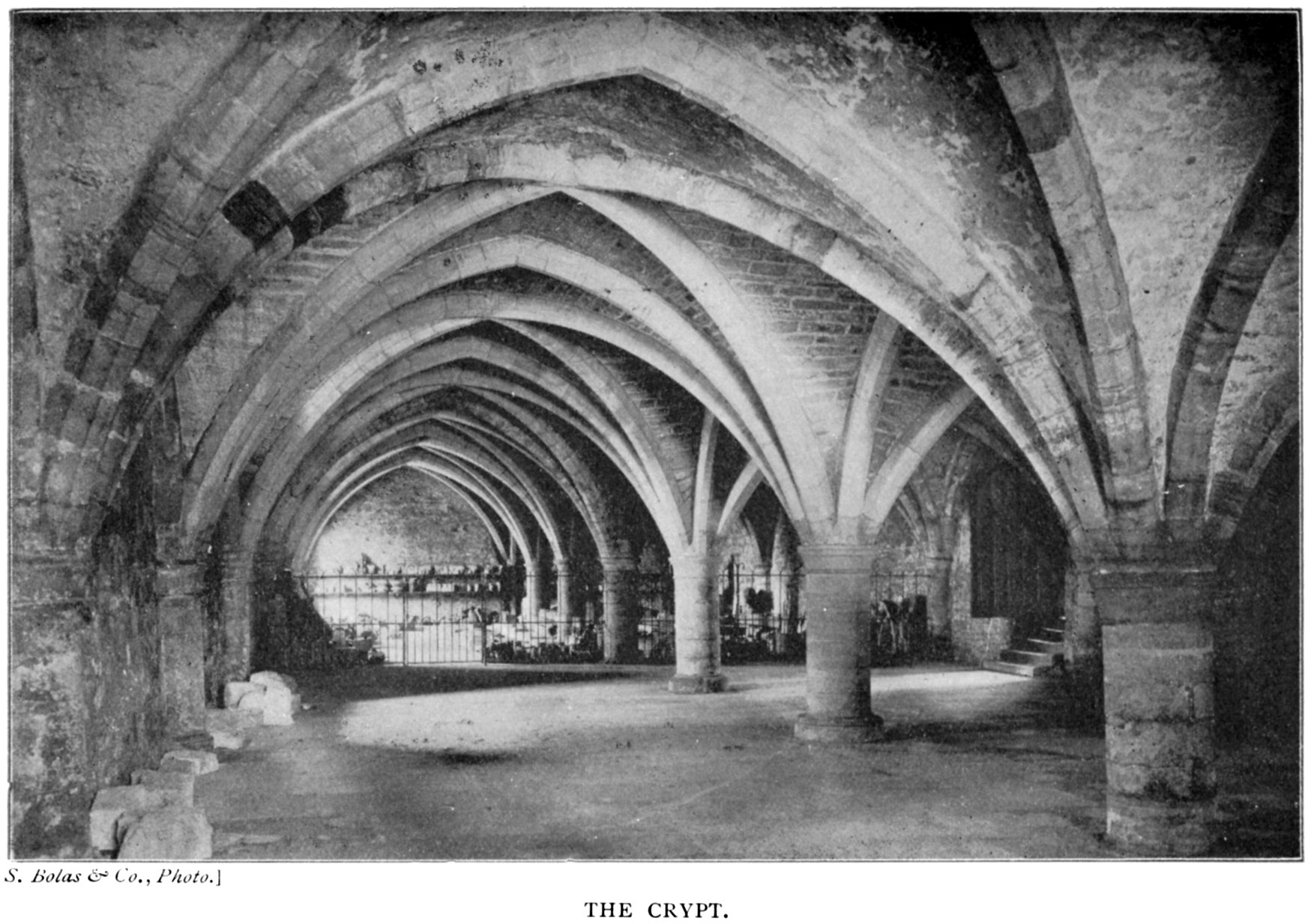
b. Durham Cathedral Crypt.
http://www.gutenberg.org/files/20191/20191-h/images/image36.jpg
Photo: St. Mary’s – Sydney
http://www.smh.com.au/news/National/Culturevultures-become-night-owls-for-nocturnal-treasure-hunt/2005/03/31/1111862534175.html
Photo: National Cathedral – Washington D.C.
http://www.pbase.com/bonazure/image/85076526
Photo: Lancing College Chapel Crypt – 1868
http://www.achome.co.uk/architecture/ac218.htm
6. Gothic crypts
a. Sagrada Familia Crypt - Barcalona
http://www.sagradafamilia.cat/sf-eng/docs_instit/pdf/construc_01.pdf
http://www.sagradafamilia.cat/sf-eng/docs_instit/pdf/construc_01.pdf
The crypt is about nine metres underground; it was excavated with just two tools: pick and shovel. The foundations and the interior of walls and vaults were made of masonry —the most common construction system at the end of the 19th century—, consisting of a mixture of chipped or semi-chipped stones,
limestone mortar and sand. The exposed stone
elements, such as columns, capitals, arches or vaults, are carved in the workshop and later put in place. Photos of construction and tools.
The Nativity façade - The foundation
This was built with the late 19th century system used for making foundations that had to bear heavy loads. It consisted of placing large prismatic ashlars whose faces had the largest possible number of planes, some on top of the others, with no mortar. The final shape of the whole foundation was pyramidal to distribute the large occasional loads over a large part of the surface area of the ground.
The pinnacles were made from the last cartwheel support and are composed of
b. La Seu Cathedral: Barcelona. The crypt is exposed directly under the alter.
http://family.webshots.com/photo/2742401590014781363lxFScB
http://www.sacred-destinations.com/spain/barcelona-cathedral-la-seu.htm
c. Worcester Cathedral Crypt
http://www.flickr.com/photos/61207929@N00/1966928985/
d. Rochester Cathedral crypt
http://www.rochestercathedral.org/virtual-tour/11.asp